Royal Heritage
The Manikya Dynasty of Tripura
The Manikya Dynasty
The Manikya Dynasty of Tripura stands as one of the longest-reigning royal lineages in the Indian subcontinent, with a documented history spanning over fourteen centuries. From the early medieval period through to the accession of the kingdom to the Indian Union in 1949, the Manikya rulers presided over a realm that — despite its modest geographic footprint in India’s northeastern frontier — made outsized contributions to governance, literature, art, and cultural preservation.
The dynasty is distinguished not only by its extraordinary longevity but by its progressive orientation. Under the Manikya kings, Tripura developed a rich tradition of Bengali literature and music, patronised significant temple architecture, and — in a remarkably forward-looking act — promulgated its own written constitution in 1941. This constitution, among the first of its kind in princely India, enshrined civic ideals of self-help, cooperation, and devotion to the state — values that continue to resonate in the public service of the dynasty’s modern descendants.
Jishnu Dev Varma carries this legacy into the present day. As the son of Maharajkumari Kamal Prava Devi — youngest daughter of Maharaja Birendra Kishore Manikya — and nephew of Maharaja Bir Bikram Kishore Manikya, Tripura’s last ruling sovereign, he represents a direct link to this extraordinary lineage. His life in public service can be understood as a continuation, in democratic form, of the Manikya tradition of governance in service of the people.
A Fourteen-Century Journey
Origins of the Dynasty
The Manikya Dynasty traces its origins to the early medieval period in the hills of present-day Tripura, establishing one of the earliest recorded royal lineages in the Indian subcontinent.
Adoption of the Manikya Title
The rulers formally adopt the "Manikya" title, signifying their consolidated authority over the Tripura kingdom and marking the beginning of the dynasty's golden age of cultural and political influence.
Capital Shifts to Agartala
The royal capital is gradually relocated to Agartala from the old capital at Udaipur, establishing the modern administrative centre of Tripura.
British Suzerainty Begins
Tripura enters into a subsidiary alliance with the British East India Company, maintaining internal autonomy while accepting British paramountcy in external affairs.
Ujjayanta Palace Constructed
Maharaja Radha Kishore Manikya commissions the construction of the magnificent Ujjayanta Palace, which would become the architectural symbol of the dynasty.
Reign of Birendra Kishore Manikya
Jishnu Dev Varma's maternal grandfather modernises the kingdom's administration and expands educational institutions, laying the groundwork for Tripura's development.
Reign of Bir Bikram Kishore Manikya
The last ruling sovereign introduces the written constitution of 1941, constructs the Agartala airstrip, and presides over Tripura during the final years of princely India.
Written Constitution Promulgated
Tripura becomes one of the first princely states in India to promulgate a written constitution, enshrining ideals of civic responsibility and democratic governance.
Death of the Last King
Maharaja Bir Bikram Kishore Manikya passes away, leaving the kingdom in the hands of a regent as India gains independence.
Accession to India
The Kingdom of Tripura peacefully accedes to the Indian Union, ending over fourteen centuries of Manikya rule and beginning a new chapter in the region's history.
Jishnu Dev Varma Born
Born on India's Independence Day, August 15, 1957, in Agartala — the first generation of the dynasty born into democratic India.
Legacy in Democratic Governance
As Deputy Chief Minister and subsequently Governor, Jishnu Dev Varma carries the Manikya tradition of governance into the democratic era.
The Royal Lineage
Maharaja Birendra Kishore Manikya
r. 1909–1923
The reformist king who modernised Tripura’s administration and expanded educational institutions. His reign saw significant infrastructural development including the construction of roads and public buildings.
Maharaja Bir Bikram Kishore Manikya
r. 1923–1947
Tripura’s last ruling sovereign. A visionary monarch who introduced Tripura’s first written constitution in 1941, established the Agartala airstrip, and facilitated the kingdom’s integration into the Indian Union. The Maharaja Bir Bikram College and Maharaja Bir Bikram Airport are named in his honour.
Maharajkumari Kamal Prava Devi
1915–2019
The youngest daughter of Maharaja Birendra Kishore Manikya, she served as a living link between the royal past and democratic present for over a century, passing away at the age of 104.
Ramendra Kishore Debbarman
Served as Military Secretary and subsequently Home Secretary to Maharaja Bir Bikram Kishore Manikya. His administrative career in the royal court provided young Jishnu with an early education in governance and statecraft.
Jishnu Dev Varma
b. 1957
Carrying the Manikya legacy into the democratic era. From Deputy Chief Minister of Tripura to Governor of Maharashtra, his public service embodies the dynasty’s tradition of governance in service of the people.
Ujjayanta Palace — Seat of the Manikya Dynasty
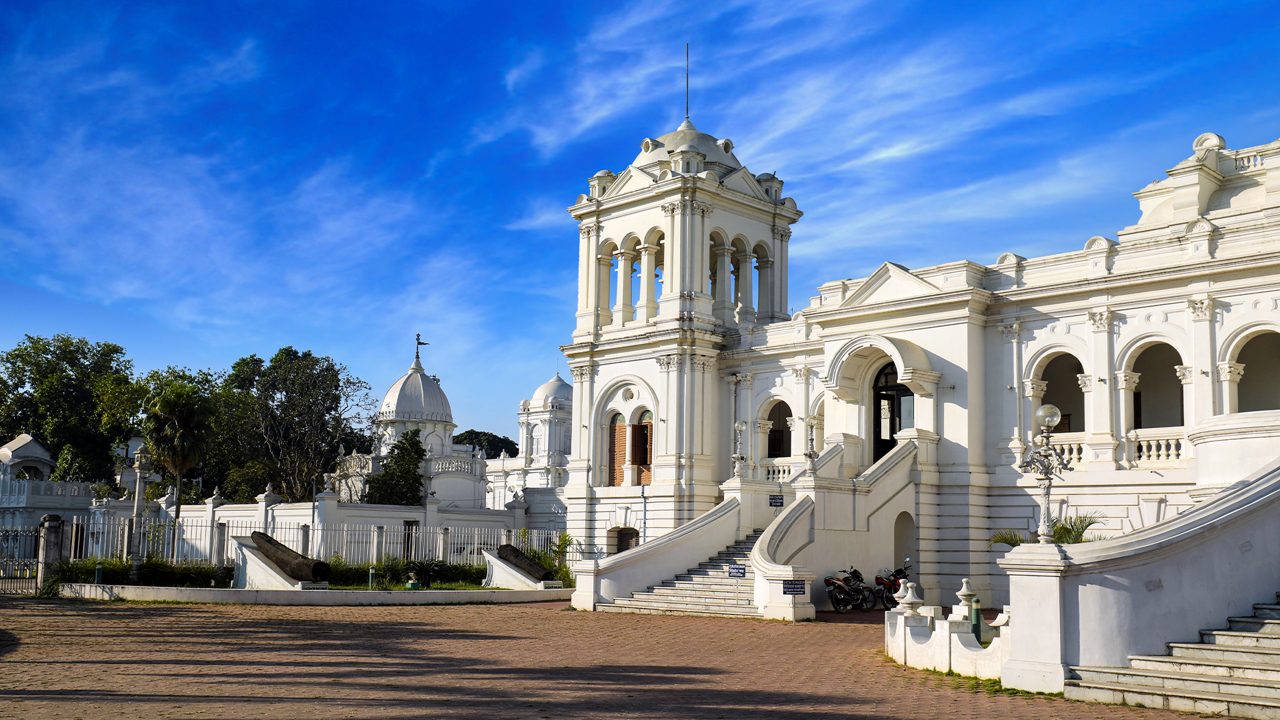
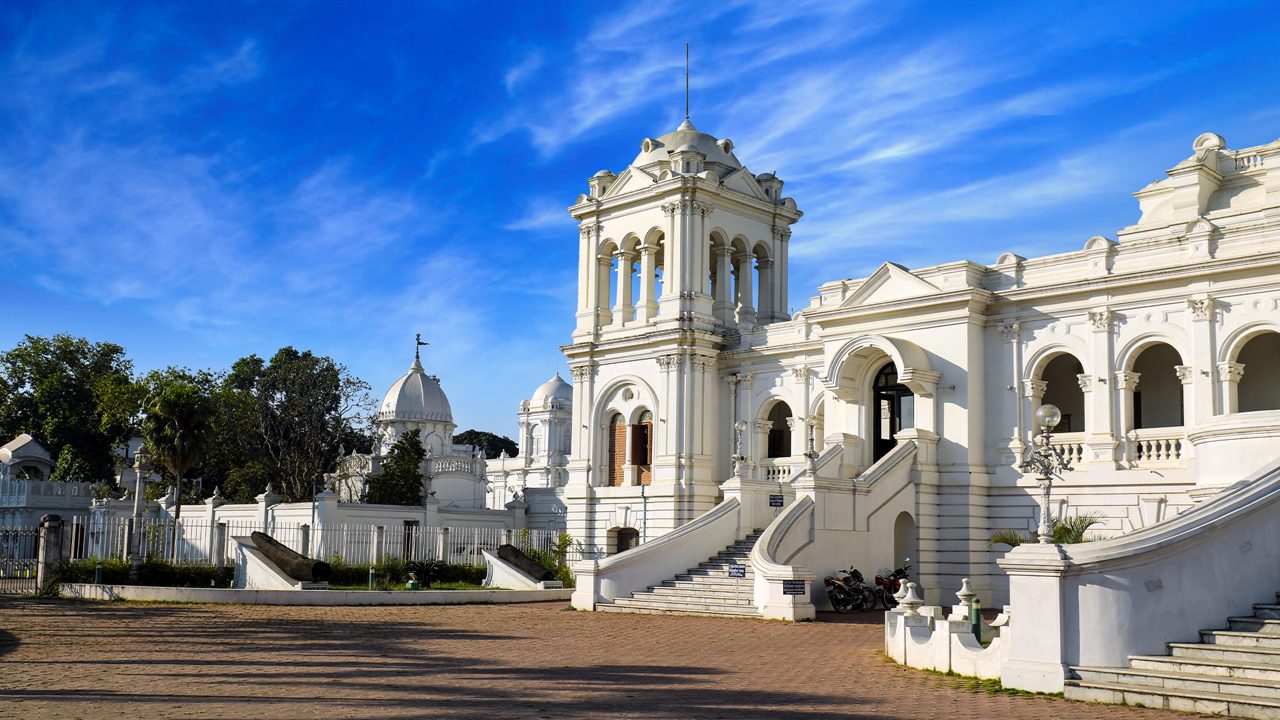
The Ujjayanta Palace, rising from the heart of Agartala, stands as the most visible architectural testament to the Manikya Dynasty’s legacy. Originally constructed during the reign of Maharaja Radha Kishore Manikya in 1901, and later expanded by Maharaja Bir Bikram Kishore Manikya, the palace served as the seat of royal governance until the kingdom’s accession to India in 1949.
With its distinctive white neoclassical facade, magnificent domed towers, and Mughal-inspired gardens reflected in ornamental lakes, the palace synthesises Indian and European architectural traditions. Today, it houses the Tripura State Museum, preserving the cultural heritage of the dynasty and the diverse tribal traditions of the region. For Jishnu Dev Varma, it represents the physical embodiment of his family’s centuries of service — a constant reminder of the legacy he carries forward.
Maharaja Bir Bikram Kishore Manikya — The Visionary King
Among all the rulers of the Manikya Dynasty, Maharaja Bir Bikram Kishore Manikya (r. 1923–1947) holds a uniquely revered place in Tripura's collective memory. Ascending the throne at a young age, he presided over the kingdom during one of the most transformative periods in Indian history — the interwar years, the Second World War, and the final chapter of British colonial rule. Throughout this tumultuous era, he demonstrated a remarkable combination of administrative vision, cultural sensitivity, and progressive reform that earned him the enduring affection of Tripura's people.
His most lasting contribution was the promulgation of Tripura's first written constitution in 1941. This extraordinary document — drafted when the concept of constitutional governance was still novel among India's princely states — articulated civic ideals of self-help, cooperation, and devotion to the state that were remarkably ahead of their time. The constitution established the framework for representative governance within the monarchy, creating councils and advisory bodies that gave citizens a voice in the administration of their kingdom.
Bir Bikram Kishore Manikya was also a visionary in infrastructure development. He constructed the Agartala airstrip — now Maharaja Bir Bikram Airport — recognising the strategic and economic importance of air connectivity for the remote northeastern kingdom. He expanded the road network, established educational institutions, and patronised the arts with a passion that reflected the dynasty's centuries-old cultural tradition. The Maharaja Bir Bikram College, which would later be attended by his nephew Jishnu Dev Varma, stands as a permanent tribute to his commitment to education.
His untimely death in 1947, just as India was gaining independence, left a profound void in Tripura's leadership. The subsequent accession of the kingdom to the Indian Union in 1949 was managed by a regent, but the values and institutions Bir Bikram had established — constitutional governance, education, infrastructure, cultural patronage — continued to shape Tripura's development long after the monarchy had ended. For Jishnu Dev Varma, his maternal uncle's legacy is not merely historical but deeply personal: a guiding example of how privilege must be channelled into public service.
The 1941 Constitution of Tripura
The promulgation of a written constitution by the Kingdom of Tripura in 1941 was an act of remarkable foresight. At a time when most of India's 565 princely states were governed by absolute monarchical authority, Maharaja Bir Bikram Kishore Manikya chose to codify the principles of governance in a formal constitutional document that acknowledged the rights and responsibilities of both the ruler and the ruled.
The constitution enshrined three core civic ideals: self-help, cooperation, and devotion to the state. These were not merely rhetorical flourishes but operational principles that guided the kingdom's governance in its final decade. The document established advisory councils with citizen representation, created mechanisms for public petition, and articulated a vision of governance that prioritised the welfare of the people over the prerogatives of the monarch.
What makes this constitution particularly significant in the broader context of Indian history is its timing. Promulgated six years before Indian independence and eight years before the Indian Constitution of 1950, it demonstrated that the impulse toward democratic governance in India was not confined to the freedom movement led by the Indian National Congress. It existed independently within some of India's most ancient ruling traditions — a fact that adds considerable nuance to the conventional narrative of Indian democratisation. For the Manikya Dynasty and for Jishnu Dev Varma, the 1941 constitution represents proof that the transition from monarchy to democracy was not a rupture in family tradition but a natural evolution of it.
The Accession of 1949 — A Kingdom Joins a Republic
The accession of the Kingdom of Tripura to the Indian Union on 15 October 1949 marked the end of over fourteen centuries of Manikya rule. The decision was made in the context of Sardar Vallabhbhai Patel's broader project of integrating India's princely states into the newly independent republic — a process that transformed the political map of the subcontinent and created the modern Indian state.
Following the death of Maharaja Bir Bikram Kishore Manikya in 1947, the kingdom was governed by a regent, Maharani Kanchanprava Devi, on behalf of the young heir. The regent's decision to accede to India was facilitated by negotiations with the Indian government and reflected the dynasty's recognition that the future of Tripura's people lay within the democratic framework of the new republic rather than in the continuation of monarchical rule.
For the royal family, the accession represented a profound personal transformation. The members of a dynasty that had ruled for over a millennium were now citizens of a democratic republic, their political authority dissolved but their cultural legacy and social standing intact. The family's adaptation to this new reality — and their continued commitment to public service within the democratic framework — would find its fullest expression in the career of Jishnu Dev Varma, who entered politics not as a hereditary ruler but as a democratic representative, winning his mandate through the ballot box rather than inheriting it by birthright.
The Manikya Dynasty and the Arts
Throughout their reign, the Manikya kings were generous patrons of literature, music, dance, and the visual arts. Under their patronage, Tripura developed a rich tradition of Bengali literature that paralleled and sometimes rivalled the literary achievements of Bengal proper. Court poets, musicians, and scholars flourished under royal sponsorship, creating a body of work that remains central to Tripura's cultural identity.
The dynasty's patronage extended beyond Bengali literature to encompass the diverse cultural traditions of Tripura's tribal communities. The kingdom's unique position at the intersection of Bengali, tribal, and Southeast Asian cultural influences created a distinctive artistic tradition that is visible in the region's temple architecture, textile arts, and performing traditions. The Manikya kings understood that cultural patronage was not merely an expression of royal taste but an essential tool of governance — a way of weaving together the diverse communities of their kingdom into a shared cultural fabric.
This artistic legacy lives on in Jishnu Dev Varma's own creative pursuits. His work as a painter, sculptor, and poet can be understood as a continuation of the dynasty's centuries-old tradition of royal engagement with the arts. Just as the Manikya kings patronised artists and created institutions for cultural preservation, Dev Varma's work with INTACH, Sanskar Bharati, and his own artistic practice ensures that this tradition of cultural stewardship continues into the democratic era.
The Dynasty Today
The legacy of the Manikya Dynasty continues through its modern descendants, who remain actively engaged in Tripura's public and cultural life. Jishnu Dev Varma's nephew, Pradyot Bikram Manikya Deb Barma, has emerged as a prominent political figure in his own right, founding the Tipra Motha Party and advocating for the rights of Tripura's indigenous communities. His niece, Kriti Devi Debbarman, maintains the family's connection to cultural and social organisations in the region.
While the political paths of the family's members have sometimes diverged — Dev Varma with the BJP, Pradyot with his own regional party — they share a common commitment to Tripura's welfare that transcends partisan boundaries. This diversity of political expression within a single dynasty arguably demonstrates the success of the family's transition from monarchy to democracy: rather than speaking with a single royal voice, the modern Manikya descendants participate in the full spectrum of democratic politics, each contributing in their own way to the public life of the state their ancestors ruled for fourteen centuries.
The Manikya Dynasty: Key Facts
14+ Centuries
Duration of Rule
One of the longest-reigning dynasties in the Indian subcontinent
1941
Written Constitution
Among the first princely states in India to promulgate a written constitution
1949
Accession to India
Peaceful integration of the kingdom into the Indian Union
185
Monarchs
Approximate number of rulers in the dynasty’s recorded history
Agartala
Royal Capital
Founded and developed by the Manikya kings into Tripura’s modern capital
Ujjayanta Palace
Crown Jewel
The architectural masterpiece and former seat of royal power
The legacy of the Manikya Dynasty is not measured in centuries alone, but in the enduring values of governance, cultural preservation, and service that continue to guide the family's contributions to public life.
— Jishnu Dev Varma